

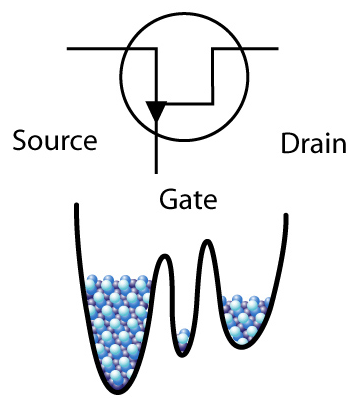
JILA Fellow Dana Z. Anderson, JILA visiting scientist Alex Zozulya, and a colleague from the Worcester Polytechnic Institute postulate that the ultracold coherent atoms in a Bose-Einstein Condensate (BEC) could be configured to act like electrons in a transistor. An “atom transistor” would exhibit absolute and differential gain, as well as allow for the movement of single atoms to be resolved in a precision scientific measurement.
The proposed device consists of trapping a BEC in three spatially separated potential energy wells. The wells, or traps, are the (1) source well, (2) gate well, and (3) drain well, as shown in the figure. When the traps are brought close together and interact, the atoms in the source well can quantum mechanically tunnel to the drain well only when the chemical potential of the gate well is roughly equal to that of the other two wells. Placing atoms in the gate well tunes its chemical potential.
Like an electronic transistor, the device shows “switching” behavior; the ratio between atoms in the drain and gate (the gain) becomes large only when a threshold number of atoms have accumulated in the gate well. This threshold value can also be changed by changing the steepness of the gate well and by changing the phase of the BEC in the gate well.
The atom transistor can be used to amplify weak atomic signals. The chemical potential of the gate is dependent upon atomic interactions. Therefore it can be very sensitively tuned by the addition of single atoms to the gate. Since the rate of tunneling between source and drain is dependent upon the chemical potential in the gate, a small change in the population of atoms in the gate will cause a larger proportionate change in the drain population.
In a slightly different configuration of the device, the three wells are extended along one dimension in a waveguide like wires in an electronic circuit. The atomic flux, analogous to the electronic current, in the gate can be amplified in the drain when the wells are brought together for a finite time to interact. In this way, time-dependent phenomena can be observed by changing the time the three wells are allowed to interact.
Anderson says the inherently quantum mechanical nature of BECs makes devices incorporating them fundamentally interesting. For instance, the use of atom transistors could increase the sensitivity of atom sensors and atom gyroscopes, which use atoms to make physical measurements. - Ryan Smith.
 The Physics Frontiers Centers (PFC) program supports university-based centers and institutes where the collective efforts of a larger group of individuals can enable transformational advances in the most promising research areas. The program is designed to foster major breakthroughs at the intellectual frontiers of physics by providing needed resources such as combinations of talents, skills, disciplines, and/or specialized infrastructure, not usually available to individual investigators or small groups, in an environment in which the collective efforts of the larger group can be shown to be seminal to promoting significant progress in the science and the education of students. PFCs also include creative, substantive activities aimed at enhancing education, broadening participation of traditionally underrepresented groups, and outreach to the scientific community and general public.